


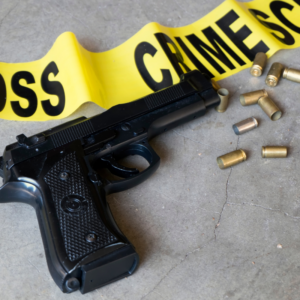
Firearms are not a marginal part of South Africa’s violent-crime problem. SAPS identifies firearms as the country’s most frequently used weapon in murder, and during one recent quarter, firearms were involved in approximately 40% of all murders. The SAPS magazine reported that 2,559 people were killed with firearms between January and March 2025 – roughly 28 firearm-related murders per day when averaged across the quarter.
In February 2026, Acting Minister of Police Firoz Cachalia provided particularly relevant context, stating that firearms remain the single largest weapon driving murder, robbery and organised crime in South Africa.
South Africa therefore has a serious firearm-violence problem. It is understandable that some stakeholders campaign for a gun-free South Africa. One such organisation is Gun Free South Africa (GFSA), which was formally established in 1995 and advocates reducing gun violence through public-policy advocacy, education, awareness and community mobilisation.
But would disarming law-abiding firearm owners actually address the source of firearm-related murder? Recent statistics raise serious questions about that proposition.
Crime by legal vs. illegal firearms
According to a written parliamentary reply by Acting Police Minister Firoz Cachalia in July 2026, 41,297 people were murdered using unlicensed firearms during the four financial years from 2022/23 to 2025/26. According to his reply, during the same period, 393 people were murdered using firearms legally owned by licensed individuals. In other words, approximately 99.1% of the firearm-related murders recorded in these figures involved unlicensed firearms, compared with 0.9% involving firearms licensed to the owner.
The distinction is important. South Africa’s firearm-crime problem appears overwhelmingly to involve firearms in the hands of criminals. Some illegal firearms do, however, enter the criminal market after being stolen, lost or diverted from legal sources. This makes responsible firearm ownership, secure storage and strict compliance with the law essential.
What does this mean for the FCAB?
It also raises a difficult question about the proposed Firearms Control Amendment Bill: if almost all firearm-related murders involve unlicensed firearms, is it rational to make lawful firearm ownership increasingly difficult for people who already comply with the law?
The proposed legislation has attracted particular concern because it seeks to remove self-defence as a recognised reason for obtaining a firearm licence, along with protection of others and protection of property. The proposal does not mean that every form of private firearm ownership would disappear – hunting and sporting licences, for example, remain part of the framework – but removing self-defence as a recognised basis for firearm ownership would represent a significant change for law-abiding South Africans who currently possess firearms to protect themselves and their families.
That makes the timing of such legislation difficult to ignore. If the overwhelming majority of firearm murders are committed with unlicensed firearms, the priority should surely be to deal with the illegal firearm supply rather than primarily restricting those who have gone through the licensing and competency process.
Place the focus where it is needed
A more targeted approach would focus on recovering stolen and lost firearms, preventing illegal firearms from entering the country, disrupting criminal networks and gangs, addressing corruption and improving the police’s ability to investigate and prosecute violent crime.
The argument for self-defence
There is also a practical consideration. South Africans do not live in an environment where the police can guarantee immediate protection whenever a violent crime occurs. A 2023 legal analysis of the proposed removal of self-defence as a basis for firearm ownership highlighted the limitations on the state’s ability to protect citizens at all times and questioned whether preventing law-abiding citizens from possessing firearms for self-defence would necessarily improve public safety.
This does not mean that every South African should own a firearm, nor does it mean that firearm ownership should be unregulated. Responsible firearm ownership requires competency, safe handling, secure storage and compliance with the law.
The question is whether law-abiding firearm owners should be treated as part of the problem when the available figures indicate that the overwhelming majority of firearm-related murders involve unlicensed firearms.
South Africa needs effective firearm control – but effective control should distinguish between firearms and firearm owners who comply with the law and those who deliberately operate outside it.
The focus should be on the illegal firearms driving violent crime, the criminals who use them and the systems that allow those firearms to circulate.
Responsible firearm ownership matters. Securing legal firearms properly helps prevent them from becoming illegal firearms tomorrow.
A safer South Africa does not necessarily require fewer law-abiding citizens to possess firearms. It requires fewer illegal firearms in the hands of criminals, more effective policing and enforcement, and a firearms-control system that ensures that responsible firearm owners remain part of the solution rather than becoming unintended targets of legislation aimed at criminals.